Showing posts with label Teaching Experience. Show all posts

Friday, 19 June 2015

Well that took longer than I thought.

I have just submitted my evidence for professional recognition. The recognition route is a process that enables individuals to demonstrate their experience and receive recognition equivalent to an initial teacher training qualification, such as the Diploma in Teaching in the Lifelong Learning Sector (DTTLS) or the Diploma in Education and Training (DET).

Basically qualified to teach without having to complete a teaching qualification because I have been teaching for so long and started before there was a requirement to gain qualifications. This is stage one the next stage is to construct a second portfolio and apply for QTLS.

To be honest at my stage in life to have to go back and do a teaching qualification would be a disappointment, not that I don't think I would learn something but because I have been a practicing teacher for so long. I have also spent a lot of time further my experience and qualifications and basically don't have the time to spend two years confirming I can teach. Instead I have spent three weeks on and off completing this process.

The process is no easy task, I wish I logged the hours I have spent on this and let me say the guidance is very vague. The most important piece of information missing is some idea of the word counts required for each section. Having taught for 25 years and been an active practitioner in both HE and FE I have a lot of evidence to draw on. The compilation of the report headings and structure is arranged below, it looks a mess but this was well worth doing.

The planning and identification of evidence
It was then just a case of compiling all the evidence and uploading to REfLECT on the SET website (SET is The Society for Education and Training and is the new professional membership organisation of the Education and Training Foundation for practitioners working in the post-16 education and training sector).

Then writing six reflections drawing on the evidence and covering the following subjects:
  • 1.0 Background Context
    • Describe your route into teaching, your roles, context and specialist subject in which you teach.
  • 2.0 Professional values and attributes
    • Showing your judgement of what works and does not work in your teaching and learning
  • 3.0 Professional knowledge and understanding   
    • Showing development of deep and critically informed knowledge and understanding in theory and practice
  • 4.0 Professional skills: Planning for learning
    • Showing the development of your expertise and skills to ensure the best outcomes for your learners
  • 5.0 Professional skills Part 2: Assessment for learning 
    • Showing development of your expertise and skills to ensure the best outcomes of your learners
  • 6.0 Concluding statement 
    • Looking back on your journey and achievements
Without the clear guidance it becomes quite difficult to know how much detail is required and it is also possible that the same evidence can be used for several sections. For example a lesson observation may identify components for all of the above sections. 

My end result constituted 156 pieces of evidence and amounted to 9000 words, I hope this isn't too much :-)


Wednesday, 17 June 2015

Food for thought

Just listen what this young man has to say.


I thought he made a lot of sense, then I watched his follow up video and realised why I chose to be an educator.


Tuesday, 9 June 2015

Recognition route is well under way.

With a couple of weeks left before final submission I have now completed the draft version of 3 sections. A slow start due to the amount of evidence I have and the requirement to thin this down. Its not easy I have been teaching for over twenty years in both HE and FE and some things have to be shared.

The IFL is now SET (The Society for Education and Training) and the route to QTLS requires a teaching qualification. Strange enough having started teaching well before the requirement for a teaching qualification I have never felt the need to get one or felt I would benefit in any way. I am already a practitioner, a Fellow of the Higher Education, an OU Tutor and a Senior lecturer. My CPD is current and having  technical qualifications in the shape of an Honours Degree and HND and a Masters in Online Distance Education I felt I was just about qualified enough. Next step was a PHd rather than a step backwards and two years on DTLS which I was dreading.

Thankfully the route to QTLS includes a recognition route to allow old and experience educators an opportunity to demonstrate competence. An easy route you may think, but it has not been for me.

So off I go then.
I started with a breakdown of the requirements, the following mindmap or spider diagram identifies the sections where evidence is required. Click on it to see it in more detail.


The next stage involved collating evidence to support each of the sections, no easy feat and I still think I may need to thin this down more but a useful exercise involved putting evidence on post its. They could then be moved around to the different sections.

Getting organised - Post-its identify evidence.
I can now focus on the write up and referencing although the guidance is very vague. No idea of word counts although it is clear that a reflective piece of writing is required linked to evidence loaded into the e-portfolio on Reflect.


Friday, 9 January 2015

Revisit Learning Theory

It's been a while since I finished my masters and whilst trying to find an old poster that I used to sum up learning theory I found the following concept map produced by Richard Millwood which was even better than my original. It is very well constructed and serves as a great summary of a vast subject.

Figure 1 - Learning Theory Concept Map (Millwood, 2013)

Several years on from completing my masters it is clear that my approach to teaching has changed. For years like many in my environment I have adopted an instructivism approach where I have taken a lead role like an actor on the stage reading and presenting a script of learning to my audience, working with educational objectives from Bloom's Taxonomy although albeit a modified version. The construction of power points presentations to support learning within the classroom and provide a road map for the session has been a tried and tested method. Now the presentations take a back seat, still there and still enhanced but mainly for the students to go over after the event on the ELE. They still form a part of my lesson structure but mainly act as guidance to keep me on track.

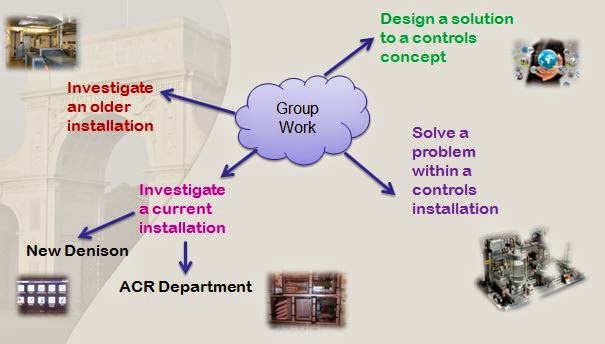
Many of my lessons now focus around the construction of knowledge rather than the instruction of knowledge. Groups work together to solve problems by doing something and one of the best tools I have for completing this is the model shown in Figure 2. A complete process model on the desktop that represents a fully working process. Learners are thrown in the deep end usually in pairs to solve a realistic task without any help from me. This is experiential learning at its best what in reality would be a dangerous situation which is broken down into a number of problem solving activities.

Figure 2 - IPC200 Process Control Model
Students get a great deal of self satisfaction getting it wrong, revising their approach and experimenting whilst they gain an understanding of a system they have never met before. They get wet and make mistakes before they learn that a systematic approach and analysis of the problem is required before delving straight into the controller.

On completion they reflect and construct a operational sequence chart on a wiki whilst the next group starts the process again. Once all groups are finished the wikis are compared and a final solution agreed. It is clear that the learner is is not a passive recipient of knowledge because I haven't passed on any information the learners have had to construct it.

What's more important it is clear the groups enjoy this learning and look for more activities like it. I am gradually obliging them, this activity just forms one a number of problem based learning activities which I continue to review as each course passes by.


References
Millwood, R.(2013) Learning Theory Concept Map. [Online] available from
http://cmapspublic3.ihmc.us/rid=1LGVGJY66-CCD5CZ-12G3/Learning%20Theory.cmap (Accessed  09 Jan 2015).


Sunday, 21 December 2014

A trip down Memory Lane

Something happened at work this week and it caused me to reflect on leaving BT back in 1995 and in particular one of the reasons why I left. Whilst a trainer in BT I took a contract to visit Nigeria and provide some training in 1992 and as a result of the success I was offered a further contract the following year to go to The Gambia which my boss refused. This was fair enough I had my teaching commitments but the following year a contract in Bangladesh was also refused and this time there was no reason, therefore this became a contributing factor for me moving on. This started me thinking I knew I had some records in the loft and thought I would revisit the trip to Nigeria and record it on my blog. Technology has moved on it has been almost 25 years since my trip to Nigeria so I thought I would have a bit of fun compile some information about the trip. I am going to add to this as I research more.


Class of 92 - You should be able to spot me :-)
Charles Ndefo, Chris Ashikodi, Sigismund Bademosi, Vincent Odunlami, Ebenezer Anjorin, Emele Kalu,  Ifeanyi Ukwanna, Owdade Aborode
Emmanuel Adeneye, Yekini Kareem, , Steve McGowan, Samuel Aro 

My Driver - the name will come back to me
The business end then, and into my classroom, the facilities were more than adequate back then I had an OHP whiteboard and flip chart what else did I need. I had also prepared a number of video walk throughs and a several boxes of photographic slides.


 My view looking into the class a varied and interesting group of Nitel Engineers with qualifications that ranged from HNCs to Degrees but all wanted to soak up all I had to say. I was in my late twenties and although I was under a lot of pressure I was well prepared. Just look at the quality of the notes provided, all having been brought with me through customs. I knew from the off that I had to hold back the notes I had been warned that some of my students may not come back once they had all the notes. Unfortunately Nigeria being Nigeria back then I had had all my pens, calculators and various other goodies removed but for some reason my notes didn't interest them.

 Obviously it wasn't all work the weekends were free and I was fortunate to be staying with two seasoned overseas BT planners, I remember their names, Frank Day and Dave Hardman, both were a great help and certainly looked after me. During the weekends I was shown a few sights and had opportunity to lay on  few of the local beeches, We had to be carful but as long as we were sensible it would be fine, well we thought so anyway.

Dave Hardman with the locals.
I found the whole experience fascinating and sat for hours chatting to the locals who would happily climb trees and feed me on coconuts and fruit. I in return would give them a few Nara or let them have my hat or the odd football shirt. 

Oranges for all, this was one shirt they didn't want but all my football shirts  never made it back to the UK.

The beeches were lined with tropical plants and palms, very quiet and a very relaxing before returning to the classroom on the Monday, The course was three weeks long and there was little time either end to enjoy Nigeria so I made the most of the weekends.

Just one of the many beautiful beeches outside of Lagos..
Sadly it was not all good news and some of the consultants working on behalf of Telconsult in the group had decided to visit a religeous shrine and gardens on the Sunday. It was a long drive and I didn't fancy wasting an oportunity to relax in the sun. Needless to say Frank, Dave and I lounged around the pool, played tennis and cooked some burgers. That evening news broke that a car containing Peter Barratt and David Parsons had been highjacked. Both had been shot David died at the scene having been shot in the neck area, he bled to death, although press releases later stated that it was a head wound. Peter had been shot twice but the bullets appeared to miss any vital organs.


On the Monday I returned to teaching somewhat apprehensive but I had to continue the course. On the journey home Monday evening my car broke down. I had a driver who's job was to look after me but I was stranded on the side of the road, somewhat concerned given what had happened the day before. Then something amazing happened a taxi pulled up and i the front seat was Peter he had been shot twice and was being moved from one hospital to another. They gave me a lift back to my flat on the way which gave me a change to find out what had happened. Peter was still shaken and David who had known for years had not survived so heaven only knows what Peter must have been feeling at this time.

I will add to this as I find more information twenty years on and some technology advancements mean I should be able to add to this article. Will I be able to track down Dave and Frank?

Wednesday, 19 June 2013

Update on my PLE

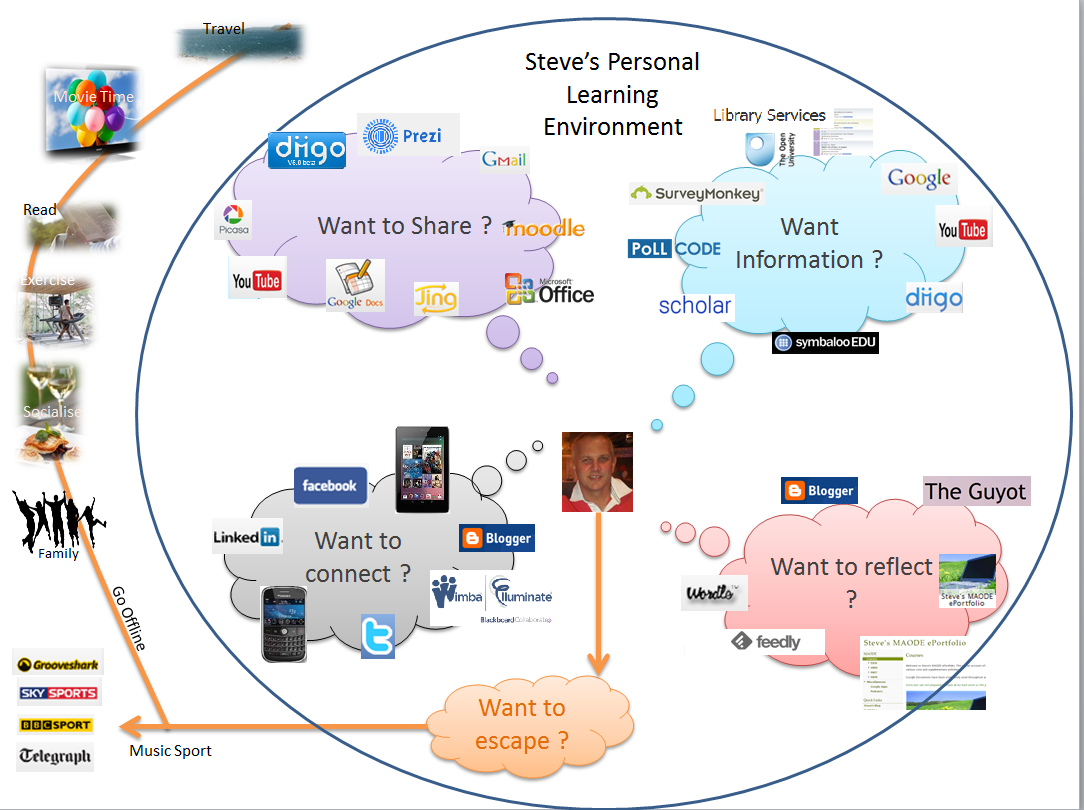
I thought it was worth revisiting my PLE to see how much has changed since I first completed my reflection on tools that I use on a regular basis. Back in 2011 my PLE looked like this. A few years down the road and its surprising how little has changed considering how fast things change on the internet. I guess this is because I choose tools that were effective from the off. Yes there have been some changes Google reader has gone being a significant change and I was quite annoyed to see Google also announce the end of  iGoogle leaving egg on my face.

However Feedly was an easy transition from Reader and Symbaloo just became more prominent as a bookmarking tool. An addition to my toybox is a Nexus and the use of evernote looks very promising. I have also experimented with publishing on YouTube and Elluminate/Blackboard collaborate is noew well embedded into my teaching and support of online learners.

I am also very please to have kept adding to my Diigo library it now has several hundred useful articles available through a search engine, its just a pity I didn't spend more time on the tagging to make them more consistent.

OK so here is my PLE Version 2


Friday, 12 April 2013

Got there !!

A fun day in London with the family.

Shaking Hands with Martin Bean OU VC, this guy has so much enthusiasm!!